Weak or manual product recommendations
Your widget does not know a men's bag from a women's one
Maestra Platform reads the catalog structure your merchandisers use, an all-in-one retention marketing platform for ecommerce brands, tuned by a forward-deployed marketer.
Brands running on Maestra






The problem
When recommendations actively work against your average order value
Some recommendation setups surface whatever is cheapest or easiest to match, quietly dragging down AOV instead of lifting it. Others require so much manual customization that teams end up doing the engine's job for it, defeating the point of automation.
What we hear from brands
an ecommerce brand with a companion mobile app sees product recommendations surfacing very low-priced items, dragging down AOV
an industrial-supplies company wants recommendations based on industry affinities and cart context, but existing solutions require heavy customization
a home goods and drinkware brand says current upsells require significant manual editing and don't effectively cross-sell between categories
The new way
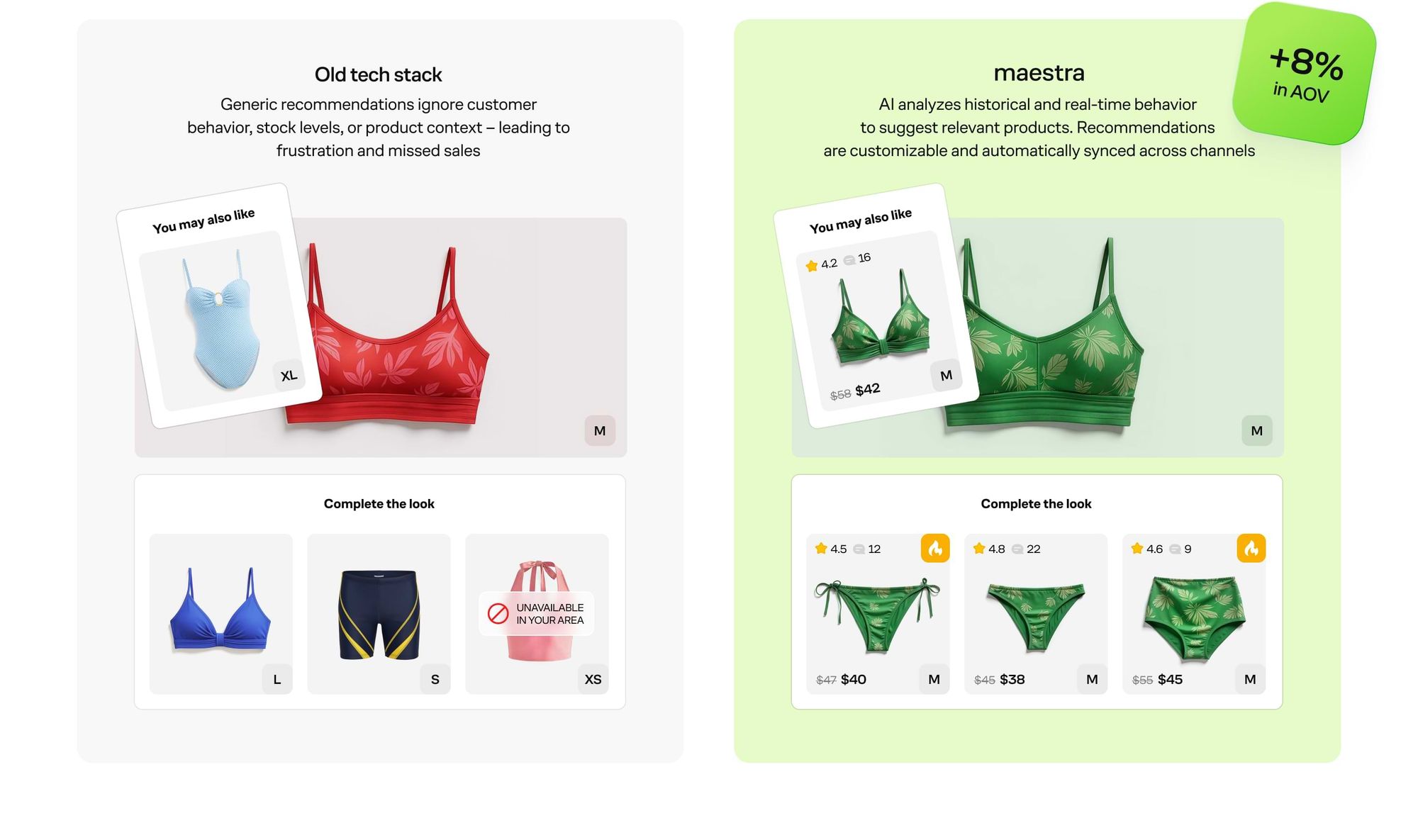
Matching that understands color, size, and material, not just category
Instead of grouping products by broad category, Maestra reads full product attributes so a red bikini top surfaces its matching bottom in the same size, material, and cut. Out-of-stock sizes are filtered out automatically, so customers never hit a dead end.
Outcomes brands report
Customer proof
Blue Q's shoppers who saw recommendations spent more

No discount changed hands. Shoppers who engaged with the recommended products simply bought more of them, and the gap between those baskets and the rest is where the growth came from.
+28.7%
higher AOV among shoppers who engaged with recommendations

How it works
Nothing goes dark while you move
Audit first
Your forward-deployed marketer maps what you run today and what it will look like once it is one platform.
Build in parallel
The new flows and segments are assembled next to the live ones, so there is no window where campaigns stop.
Cut over deliberately
You go live channel by channel on a date you picked, with the old stack still standing behind you until you do not need it.
The platform
Enterprise capability, ecommerce timeline
The heavy parts of an enterprise CDP are already built and already connected to the channels, so the work left is configuration rather than a platform project. Brands get capability that used to take a year of integration.
Including
Your forward-deployed marketer
The account load is the whole trick
Attentive service depends less on goodwill than on arithmetic. A Maestra marketer carries fewer than 15 accounts where 60 or more is normal elsewhere, which is what makes a 5-minute response and four strategy meetings a month something you can plan around.
Fewer than 15 accounts per marketer, versus 60+ industry-wide
5-minute response time versus 72 hours elsewhere
4 strategy meetings a month instead of 1
Replace your stack
The connectors go too
Every tool in a stack needs a connection to the store and to the other tools, and each of those is a thing that breaks quietly. Consolidating removes the maintenance along with the vendors.
Replaces
Zapier
Klaviyo
Nosto
Wisepops
Rebuy
Ask an expert what Maestra would change for you
Come with your current numbers. We will tell you plainly what moving to Maestra would look like.